
AvalancheClarity

Pelvoux

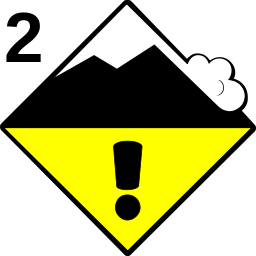
Danger level 2 Moderate
Bulletin date: Tuesday, 31 March 2026 at 14:00 UTC
Valid until:

Ski resorts in this massif: Puy-Saint-Vincent, Pelvoux-Vallouise, Les Hautes Navières

Source: Météo-France

This is an AI-generated translation and summary. It may contain errors. Always read the full official Météo-France avalanche bulletin before any mountain activity.

Get AvalancheClarity on your phone — bulletins, translations, and push notifications when new reports are published.

Download the App
1 2 3 4 5

Avalanche risk assessment bulletin

(valid outside marked and open runs)

MASSIF : Pelvoux

written on Tuesday, March 31, 2026 at 4 p.m.

To view current alerts, please visit the website https://vigilance.meteofrance.fr/fr

Risk assessment for Wednesday, April 01, 2026

A FEW SLABS AT ALTITUDE IN WIND SLAB


            Risque détaillé
NESW

Risk indices: 5 very high - 4 high - 3 considerable - 2 moderate - 1 low -- In black: the most dangerous slopes

Above 2200 m moderate risk index, lower down low index.

Natural releases: a wind-overloaded slab can release spontaneously. Limited size.

Ski-triggered releases: instabilities in wind slab, thicker at the edge of Oisans.

Stability of the snowpack until Wednesday evening, April 01

Typical avalanche situation:Neige ventéeWind slab

Triggered releases: hard slabs in place in wind slab and maintained by the moderate Lombarde. Present above approximately 2200 m on aspects in a wide northern sector (west, north and north-east), these slabs are nevertheless more numerous and sensitive towards Oisans where new snow amounts are slightly higher. Easily triggered by a skier's passing, these instabilities generate small (size 1) or even medium (size 2) avalanches, especially towards Écrins/Agneaux/Combeynots. 

Natural releases: rare failures due to wind loading (e.g. cornice collapse). Small to medium avalanche (size 1, rarely 2). 

Snow quality

    Snow cover is close to normal or above average for late March.
Observed snow depths: 295 cm at the Écrins Nivôse around 3000 m, 189 cm at Pré de Mme Carle at 1900 m.

Skiable snow limit: from 1400 m on favorable north-facing slopes (grassy terrain, forest tracks), 1800/1900 m on not-too-steep south-facing slopes.

Surface snow condition: recent snow heavily worked by the wind, but locally still light in well-sheltered sectors. On the ridges, thick cornices sit alongside wind-scoured areas.  
On south-facing slopes, crusted snow below 2500 m.
  

Weather overview for Wednesday, April 01

nightmorningafternoonevening
Dry and still windy. 0°C at 2000 m and -8°C at 3000 m.
Rain-Snow----
Iso 0°C1500 m1900 m2300 m1700 m
Wind 2000 m 35 km/h 30 km/h 40 km/h 30 km/h
Wind 3000 m 45 km/h 40 km/h 50 km/h 45 km/h

Off-piste snow depth

Tue. 31 March N S 220 cm 2500 m 160 cm 2000 m 40 cm 1500 m 140 cm 2500 m 80 cm 2000 m 0 cm 1500 m Continuous snow cover altitudes: North face : 1400 m South face : 1700 m

Precipitation at 1800 m

Cumulated quantities in 24 hours Fresh snow at 1800m Fresh snow Min Fresh snow Max Rain 5 Snow (cm) / Rain (mm) 0 0 0 Sat. 28 at 6h 1 2 0 Sun. 29 at 6h 0 0 0 Mon. 30 at 6h 1 3 0 Tue. 31 at 6h 0 0 0 Wed. 1 at 6h 0 0 0 Thu. 2 at 6h

Trend for Thursday, April 02

Moderate risk index

Moderate risk maintained with residual slabs at altitude. Resumed wetting on south-facing slopes.

Snow-weather conditions for the last 7 days

Last 7 days

Wed. 25/03Thu. 26/03Fri. 27/03Sat. 28/03Sun. 29/03Mon. 30/03Tue. 31/03
03h09h15h21h03h09h15h21h03h09h15h21h03h09h15h21h03h09h15h21h03h09h15h21h03h09h15h21h
Weather
Wind
(km/h)
at 3000m
25508085909590807040101020253035302020203050809080706050
Wind
(km/h)
at 2000m
1020557070707070704010515253030302025203040608070555045
Iso 0°CRain-snow limit
Altitude (m)
2400
1600
800
0
Wed. 25/03Thu. 26/03Fri. 27/03Sat. 28/03Sun. 29/03Mon. 30/03Tue. 31/03
Fresh
snow (6h)
7 cm5 cm0 cm2 cm0 cm3 cm
Avalanche
Risk
Snow cover North and South at  1500m···   2000m- - -   2500m
Total snow
depth (cm)
240
160
80
0
50505045454040165165165165165160160220220220220220220220
Wed. 25/03Thu. 26/03Fri. 27/03Sat. 28/03Sun. 29/03Mon. 30/03Tue. 31/03
Snow limit - North face   Snow limit - South face
Snow
limit (m)
2400
2100
1800
1500
1200
900
600
300
0
1400140014001400140014001400 1800180018001800180018001700
Wed. 25/03Thu. 26/03Fri. 27/03Sat. 28/03Sun. 29/03Mon. 30/03Tue. 31/03
Iso 0°C RSL Weather at
1800m
Wind at
2000m
Wind at
3000m
Wed. 25/0303h2 600-
10
25
09h2 500-
20
50
15h2 0001 700
55
80
21h1 000500
70
85
Thu. 26/0303h900500
70
90
09h900500
70
95
15h1 100500
70
90
21h900500
70
80
Fri. 27/0303h1 000-
70
70
09h1 300-
40
40
15h1 800-
10
10
21h2 000-
5
10
Sat. 28/0303h2 000-
15
20
09h2 000-
25
25
15h1 800-
30
30
21h1 200-
30
35
Sun. 29/0303h1 000900
30
30
09h1 200-
20
20
15h1 700-
25
20
21h2 000-
20
20
Mon. 30/0303h2 000-
30
30
09h2 100-
40
50
15h2 300-
60
80
21h1 5001 000
80
90
Tue. 31/0303h1 300800
70
80
09h1 200-
55
70
15h1 800-
50
60
21h1 400-
45
50
Avalanche
risk
Snow limit Snow depth at
2000m
Fresh snow at
1800m
Wed. 25/03N : 1 400 m
S : 1 800 m
N : 165 cm
S : 80 cm
7 cm
Thu. 26/03N : 1 400 m
S : 1 800 m
N : 165 cm
S : 80 cm
5 cm
Fri. 27/03N : 1 400 m
S : 1 800 m
N : 165 cm
S : 80 cm
0 cm
Sat. 28/03N : 1 400 m
S : 1 800 m
N : 165 cm
S : 80 cm
2 cm
Sun. 29/03N : 1 400 m
S : 1 800 m
N : 165 cm
S : 80 cm
0 cm
Mon. 30/03N : 1 400 m
S : 1 800 m
N : 160 cm
S : 80 cm
3 cm
Tue. 31/03N : 1 400 m
S : 1 700 m
N : 160 cm
S : 80 cm

The documentation useful for correctly reading this BRA is available on the 2025 avalanche guide

Written by Météo-France with the contribution of observers from the nivo-meteorological network. Partnership: ANMSM (Mountain Resort Mayors), DSF (Ski Areas of France), ADSP (Ski Run and Safety Directors of Winter Sports Resorts) and other mountain stakeholders.

French Translation & Notes

QUELQUES PLAQUES EN ALTITUDE DANS LA NEIGE VENTÉE

A FEW SLABS AT ALTITUDE IN WIND-DRIFTED SNOW

The title identifies the main problem: plaques (slabs) and neige ventée (wind-drifted snow).

Déclenchements provoqués : plaques dures en place dans la neige ventée et entretenues par la Lombarde modérée.

Triggered releases: hard slabs in place within wind-drifted snow and maintained by the moderate Lombarde wind.

Déclenchements provoqués refers to human-triggered avalanches. The Lombarde is a specific wind from the east/southeast common in this region.

Présentes au-dessus de 2200 m environ dans les orientations d'un large secteur nord (ouest, nord et nord-est) , ces plaques sont néanmoins plus nombreuses et sensibles vers l'Oisans où les quantités de neige fraîche sont un peu plus importantes.

Present above approximately 2200 m on aspects in a wide northern sector (west, north, and northeast), these slabs are nevertheless more numerous and sensitive towards the Oisans where fresh snow amounts are slightly higher.

Sensibles here means reactive or easy to trigger. Oisans refers to the nearby mountain massif.

Facilement déclenchables par le passage d'un skieur, ces instabilités génèrent des avalanches de taille petite (taille 1), voire moyenne (taille 2), notamment vers Écrins/Agneaux/Combeynots.

Easily triggered by the passage of a skier, these instabilities generate avalanches of small size (size 1), or even medium (size 2), especially towards Écrins/Agneaux/Combeynots.

Voire means 'even' or 'indeed', used to introduce a more significant possibility. Passage d'un skieur is the standard way to describe a single human load.

Départs spontanés : rares ruptures par surcharge du au vent (rupture de corniche par exemple).

Natural releases: rare failures due to wind loading (e.g., cornice failure).

Départs spontanés means natural releases. Surcharge refers to the extra weight/load added by wind-blown snow.

Avalanche petite à moyenne (taille 1, rarement 2).

Small to medium avalanche (size 1, rarely 2).

Refers to the expected size of natural releases.

Temps sec et encore venté.

Dry and still windy weather.

Temps sec means dry weather; venté means windy.

0° à 2000 m et -8° à 3000 m.

0°C at 2000 m and -8°C at 3000 m.

Temperature data for different altitudes.

L'enneigement est proche des normales ou excédentaire pour une fin mars.

Snowpack is close to normal or above average for late March.

Enneigement refers to the snow coverage or snowpack. Excédentaire means there is more snow than usual (a surplus).

Hauteurs de neige observées : 295 cm à la Nivôse des Écrins vers 3000 m, 189 cm au Pré de Mme Carle à 1900 m.

Observed snow depths: 295 cm at the Écrins Nivôse station near 3000 m, 189 cm at Pré de Mme Carle at 1900 m.

Nivôse is an automated high-altitude weather station in France.

Limite d'enneigement skiable : dès 1400 m en ubacs favorables (terrains herbeux, pistes forestières), 1800/1900 m en adrets pas trop raides.

Skiable snow limit: from 1400 m on favorable north-facing slopes (grassy terrain, forest tracks), 1800/1900 m on south-facing slopes that are not too steep.

Ubacs are shaded, north-facing slopes. Adrets are sunny, south-facing slopes. This is essential alpine vocabulary.

État de la neige de surface : neige récente fortement travaillée par le vent, mais localement encore légère dans les secteurs bien abrités.

Surface snow state: recent snow heavily affected by the wind, but locally still light in well-sheltered sectors.

Travaillée par le vent (worked by the wind) is a common way to describe wind-affected or wind-packed snow.

Sur les crêtes, d'épaisses corniches côtoient des zones pelées par le vent.

On the ridges, thick cornices sit alongside wind-scoured areas.

Zones pelées (peeled zones) describes areas where the wind has stripped away the snow down to the ground or a hard layer.

En versant sud, neige croutée sous 2500 m.

On southern slopes, crusted snow below 2500 m.

Croutée means the snow has formed a hard crust, usually due to sun or wind.

French Term English Term Definition
Taille 1 Size 1 Small avalanche (sluff). Unlikely to bury a person but can knock you off your feet or carry you into terrain traps.
Taille 2 Size 2 Medium avalanche. Can bury, injure, or kill a person.
Risque 2 - Limité 2 - Moderate Snowpack is moderately well bonded on some steep slopes, otherwise generally well bonded. Triggering is possible with high additional loads, particularly on indicated steep slopes. Large natural avalanches unlikely.
Indices de risque Risk Indices The European Avalanche Danger Scale: 1 (Low) = generally stable; 2 (Moderate) = possible on steep slopes; 3 (Considerable) = triggering possible even by a single skier; 4 (High) = likely even from low loads, natural releases expected; 5 (Very High) = widespread natural avalanches, extremely dangerous.
Plaque à vent Wind slab A cohesive layer of wind-deposited snow on the lee side of ridges, crests, or obstacles. Often hard or stiff on the surface but resting on a weaker layer beneath. Can be triggered by a single skier.
Départ spontané Natural release An avalanche that releases without human intervention, triggered by natural factors such as new snowfall, wind loading, warming, or rain. Indicates the snowpack is unstable enough to fail on its own.
Déclenchement provoqué Skier-triggered release An avalanche caused by the weight of a person (skier, snowboarder, hiker) or by explosives. The additional load collapses a weak layer, causing the slab above to fracture and slide.
Manteau neigeux Snowpack The total accumulation of all snow layers on the ground. Its structure — the arrangement and bonding of different layers — determines avalanche risk.
Corniche Cornice An overhanging mass of wind-deposited snow on the edge of a ridge or crest. Can break off unexpectedly and trigger avalanches on the slope below.
Surcharge Additional load Extra weight applied to the snowpack — a skier, group of skiers, new snowfall, or rain. Even a single person can be enough to trigger a slab avalanche on an unstable slope.
Plaque Slab A cohesive layer of snow that can fracture and slide as a unit when a weak layer beneath it collapses. Slabs can be soft or hard, and vary from small to enormous.
Lombarde Lombarde wind A local wind in the French Alps that blows from the east or southeast, often coming across the Italian border.
neige ventée wind-drifted snow Snow that has been moved and deposited by the wind, often forming instabilities.
ubacs north-facing slopes Slopes that are primarily shaded and north-facing; the opposite of adrets.
adrets south-facing slopes Slopes that face the sun (south-facing); the opposite of ubacs.
neige croutée crusted snow A hard surface layer on the snowpack, often created by sun-melting followed by freezing or by wind action.
1 2 3 4 5

Bulletin d'estimation du risque d'avalanche

(valable en dehors des pistes balisées et ouvertes)

MASSIF : Pelvoux

rédigé le mardi 31 mars 2026 à 16 h.

Pour consulter la vigilance en cours, veuillez vous rendre sur le site https://vigilance.meteofrance.fr/fr

Estimation des risques pour le mercredi 01 avril 2026

QUELQUES PLAQUES EN ALTITUDE DANS LA NEIGE VENTÉE


            Risque détaillé
NESO

Indices de risque : 5 très fort - 4 fort - 3 marqué - 2 limité - 1 faible -- En noir : les pentes les plus dangereuses

Au-dessus de 2200m indice de risque limité, plus bas indice faible.

Départs spontanés : une plaque surchargée par le vent peut céder spontanément. Taille limitée.

Déclenchements skieurs : instabilités dans la neige ventée, plus épaisses en bordure de l'Oisans.

Stabilité du manteau neigeux jusqu'au mercredi 01 avril au soir

Situation avalancheuse typique :Neige ventéeNeige ventée

Déclenchements provoqués : plaques dures en place dans la neige ventée et entretenues par la Lombarde modérée. Présentes au-dessus de 2200 m environ dans les orientations d'un large secteur nord (ouest, nord et nord-est) , ces plaques sont néanmoins plus nombreuses et sensibles vers l'Oisans où les quantités de neige fraîche sont un peu plus importantes. Facilement déclenchables par le passage d'un skieur, ces instabilités génèrent des avalanches de taille petite (taille 1), voire moyenne (taille 2), notamment vers Écrins/Agneaux/Combeynots. 

Départs spontanés : rares ruptures par surcharge du au vent (rupture de corniche par exemple). Avalanche petite à moyenne (taille 1, rarement 2). 

Qualité de la neige

    L'enneigement est proche des normales ou excédentaire pour une fin mars.
Hauteurs de neige observées : 295 cm à la Nivôse des Écrins vers 3000 m, 189 cm au Pré de Mme Carle à 1900 m.

Limite d'enneigement skiable : dès 1400 m en ubacs favorables (terrains herbeux, pistes forestières), 1800/1900 m en adrets pas trop raides.

État de la neige de surface : neige récente fortement travaillée par le vent, mais localement encore légère dans les secteurs bien abrités. Sur les crêtes, d'épaisses corniches côtoient des zones pelées par le vent.  
En versant sud, neige croutée sous 2500 m.
  

Aperçu météo pour le mercredi 01 avril

nuitmatinaprès-midisoir
Temps sec et encore venté. 0° à 2000 m et -8° à 3000 m.
Pluie-Neige----
Iso 0°C1500 m1900 m2300 m1700 m
Vent 2000 m 35 km/h 30 km/h 40 km/h 30 km/h
Vent 3000 m 45 km/h 40 km/h 50 km/h 45 km/h

Epaisseur de neige hors-piste

mar. 31 mars N S 220 cm 2500 m 160 cm 2000 m 40 cm 1500 m 140 cm 2500 m 80 cm 2000 m 0 cm 1500 m Altitudes d'enneigement continu : Versant NORD : 1400 m Versant SUD : 1700 m

Précipitations à 1800 m

Quantités cumulées en 24 heures Neige fraîche à 1800m Neige fraîche Min Neige fraîche Max Pluie 5 Neige (cm) / Pluie (mm) 0 0 0 sam. 28 à 6h 1 2 0 dim. 29 à 6h 0 0 0 lun. 30 à 6h 1 3 0 mar. 31 à 6h 0 0 0 mer. 1 à 6h 0 0 0 jeu. 2 à 6h

Tendance du jeudi 02 avril

Indice de risque limité

Maintien d'un risque limité avec des plaques résiduelles en altitude. Reprise de l'humidification en sud.

Conditions nivo-météo des 7 derniers jours

Les 7 derniers jours

mer. 25/03jeu. 26/03ven. 27/03sam. 28/03dim. 29/03lun. 30/03mar. 31/03
03h09h15h21h03h09h15h21h03h09h15h21h03h09h15h21h03h09h15h21h03h09h15h21h03h09h15h21h
Météo
Vent
(km/h)
à 3000m
25508085909590807040101020253035302020203050809080706050
Vent
(km/h)
à 2000m
1020557070707070704010515253030302025203040608070555045
Iso 0°CLimite pluie-neige
Altitude en m
2400
1600
800
0
mer. 25/03jeu. 26/03ven. 27/03sam. 28/03dim. 29/03lun. 30/03mar. 31/03
Neige
fraîche (6h)
7 cm5 cm0 cm2 cm0 cm3 cm
Risque
d'Avalanche
Enneigement versant Nord et Sud à  1500m···   2000m- - -   2500m
Hauteur totale
de neige (cm)
240
160
80
0
50505045454040165165165165165160160220220220220220220220
mer. 25/03jeu. 26/03ven. 27/03sam. 28/03dim. 29/03lun. 30/03mar. 31/03
Limite de l'enneigement - Versant Nord   Limite de l'enneigement - Versant Sud
Limite
d'enneigement (m)
2400
2100
1800
1500
1200
900
600
300
0
1400140014001400140014001400 1800180018001800180018001700
mer. 25/03jeu. 26/03ven. 27/03sam. 28/03dim. 29/03lun. 30/03mar. 31/03
Iso 0°C LPN Météo à
1800m
Vent à
2000m
Vent à
3000m
mer. 25/0303h2 600-
10
25
09h2 500-
20
50
15h2 0001 700
55
80
21h1 000500
70
85
jeu. 26/0303h900500
70
90
09h900500
70
95
15h1 100500
70
90
21h900500
70
80
ven. 27/0303h1 000-
70
70
09h1 300-
40
40
15h1 800-
10
10
21h2 000-
5
10
sam. 28/0303h2 000-
15
20
09h2 000-
25
25
15h1 800-
30
30
21h1 200-
30
35
dim. 29/0303h1 000900
30
30
09h1 200-
20
20
15h1 700-
25
20
21h2 000-
20
20
lun. 30/0303h2 000-
30
30
09h2 100-
40
50
15h2 300-
60
80
21h1 5001 000
80
90
mar. 31/0303h1 300800
70
80
09h1 200-
55
70
15h1 800-
50
60
21h1 400-
45
50
Risque
avalanche
Limite enneigement Enneigement à
2000m
Neige fraîche à
1800m
mer. 25/03N : 1 400 m
S : 1 800 m
N : 165 cm
S : 80 cm
7 cm
jeu. 26/03N : 1 400 m
S : 1 800 m
N : 165 cm
S : 80 cm
5 cm
ven. 27/03N : 1 400 m
S : 1 800 m
N : 165 cm
S : 80 cm
0 cm
sam. 28/03N : 1 400 m
S : 1 800 m
N : 165 cm
S : 80 cm
2 cm
dim. 29/03N : 1 400 m
S : 1 800 m
N : 165 cm
S : 80 cm
0 cm
lun. 30/03N : 1 400 m
S : 1 800 m
N : 160 cm
S : 80 cm
3 cm
mar. 31/03N : 1 400 m
S : 1 700 m
N : 160 cm
S : 80 cm

La documentation utile à la bonne lecture de ce BRA est disponible sur le guide avalanche 2025

Rédigé par Météo-France avec la contribution des observateurs du réseau nivo-météorologique. Partenariat : ANMSM (Maires de Stations de Montagne), DSF (Domaines Skiables de France), ADSP (Directeurs de Pistes et de la Sécurité des Stations de Sports d'Hiver) et autres acteurs de la montagne.